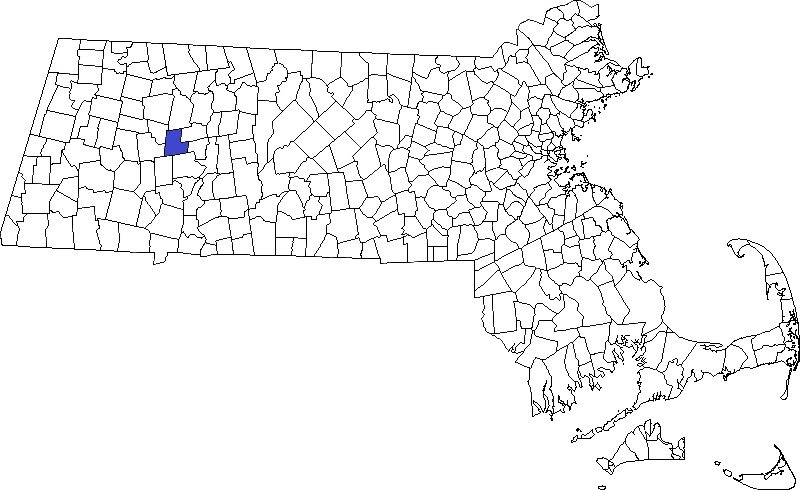
Location: Veterans Memorial Park, 6 Main Street, Williamsburg
Coordinates: 42°23’31.5″N 72°43’48.8″W
Date dedicated: September 4, 1921 (Civil War and WWI plaques)
Design/Sculptor/Manufacturer: Unknown
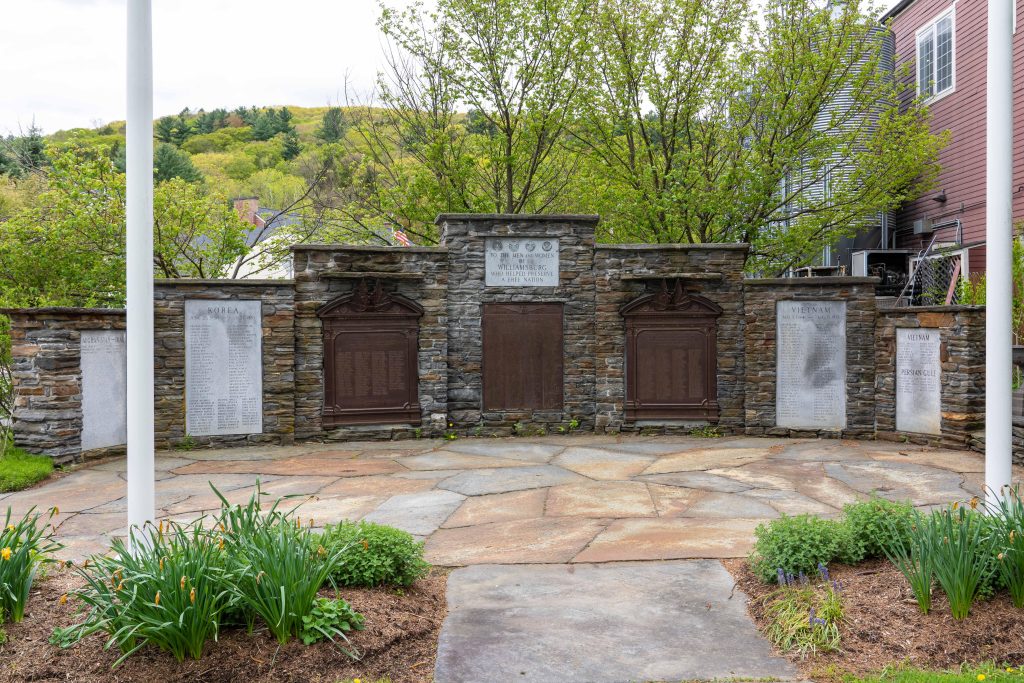
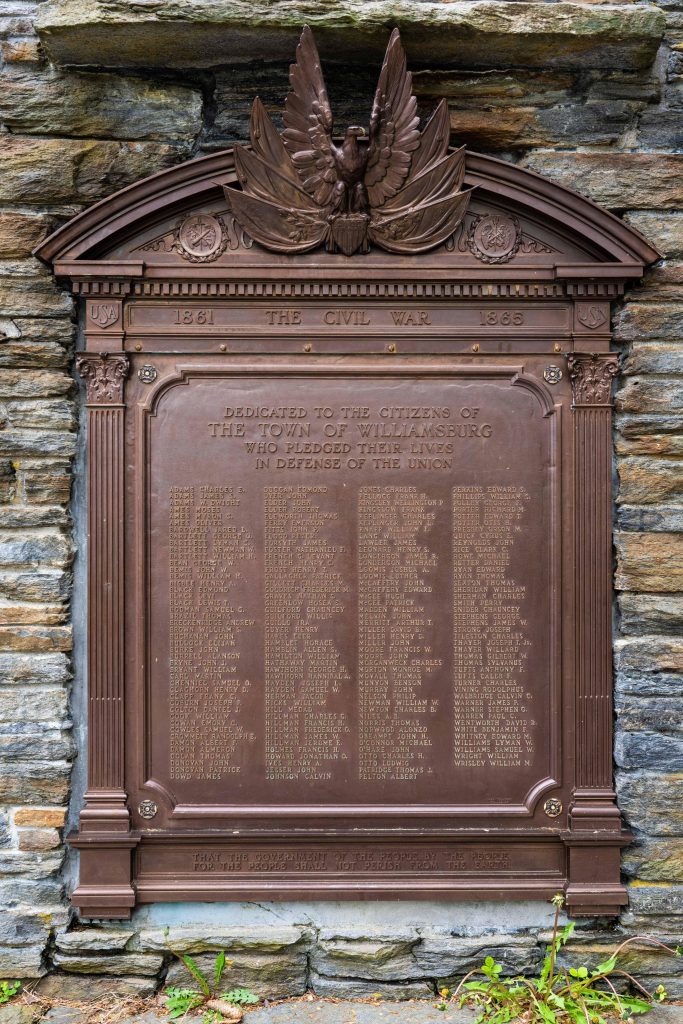
The Williamsburg Veterans Memorial is a collection of various plaques that were dedicated at different times and eventually gathered in one central location in the middle of Williamsburg. According to a post by the Meekins Library, “The Memorial started as two bronze plaques for Civil War and World War I veterans affixed to the façade of the Helen E. James School. They were dedicated during the town’s 150th anniversary celebration in 1921.”[1]
The dedication of the plaques was scheduled for early afternoon on the third day of the tremendous anniversary celebration. Vice-President Calvin Coolidge was the guest of honor. He was scheduled to give a lengthy address later in the day on the fairgrounds at Tetro’s Field—an event that would be attended by 7,000 people. By comparison, the preceding dedication of the memorial plaques at the Helen E. James School was a simple affair. To commence the ceremony, a group of WWI veterans escorted the Vice-President and his wife to the school. After a prayer and some preliminary remarks, Coolidge and his wife were called upon to unveil the plaques which were affixed on either side of the main entrance. Major Thomas J. Hammond of Northampton then gave the dedicatory address. He reflected on the spirit which inspired civilizations to build memorials over the course of history. He contrasted the “spirit of conquest” which drove ancient people to build memorials with the love of liberty and justice which motivated Americans to do so.[2]
“Let us pledge ourselves,” Major Hammond concluded, “to the principles that might shall never rule as might alone, that right shall ever govern, and loyalty lead us.”
In 1951, Williamsburg’s Soldiers Memorial Park was established on ground donated by the Grange. The location had previously been the site of the 1832 Methodist Church, torn down around 1944. Initially the park featured a single stone monument honoring WWII veterans. Finally, in 1971, the town carried out a project to create a larger Veterans Memorial Park, bringing the Civil War and WWI bronze plaques to join the WWII memorial and placing other plaques for more recent wars. Thus, as the Meekins Library staff put it, “bringing together the names of veterans from all wars in a single place.”
The Civil War plaque lists 174 men connected to Williamsburg who served in the Civil War (some of these were veterans from other towns who moved to Williamsburg after the war). At least 28 Williamsburg soldiers died in the war. Nearly all those who were killed in action or died of wounds belonged to the 37th Massachusetts Infantry. This western Massachusetts unit was organized in Pittsfield and was attached to the Army of the Potomac. Most of the Williamsburg casualties took place in May 1864 during the Overland Campaign.
In a history of Williamsburg, there are some reflections uttered by a Civil War veteran during a different event, providing a sense of local memory of the war.
During an “Old Folks Day”—a festive reunion of older Williamsburg natives held in 1888—Henry S. Gere, who had served as a private with the 52nd Massachusetts in Louisiana, was elected chairman of the day. He reflected on their shared, collective memories of the past decades, including the war itself. Of those war years, he said, “It has fallen to the older people here assembled to witness the greatest Civil War the world has ever seen. We have passed through all its trials, felt all its horrors, and tasted liberally of its bitter hardships…What a mighty revolution it created! It overturned and destroyed the most monstrous system of slavery that ever existed and liberated four million human beings.”[3]
[1] Meekins Library, “#throwbackthursday”, Facebook, November 21, 2021.
[2] “Only by Return to Work Can Problems of Nation Be Solved, Says Coolidge,” The Morning Union (Springfield, MA), September 5, 1921, 1-2.
[3] H. S. Gere’s address, reprinted in Phyllis B. Deming, A History of Williamsburg in Massachusetts (Northampton, MA: The Hampshire Bookshop, 1946), 307.