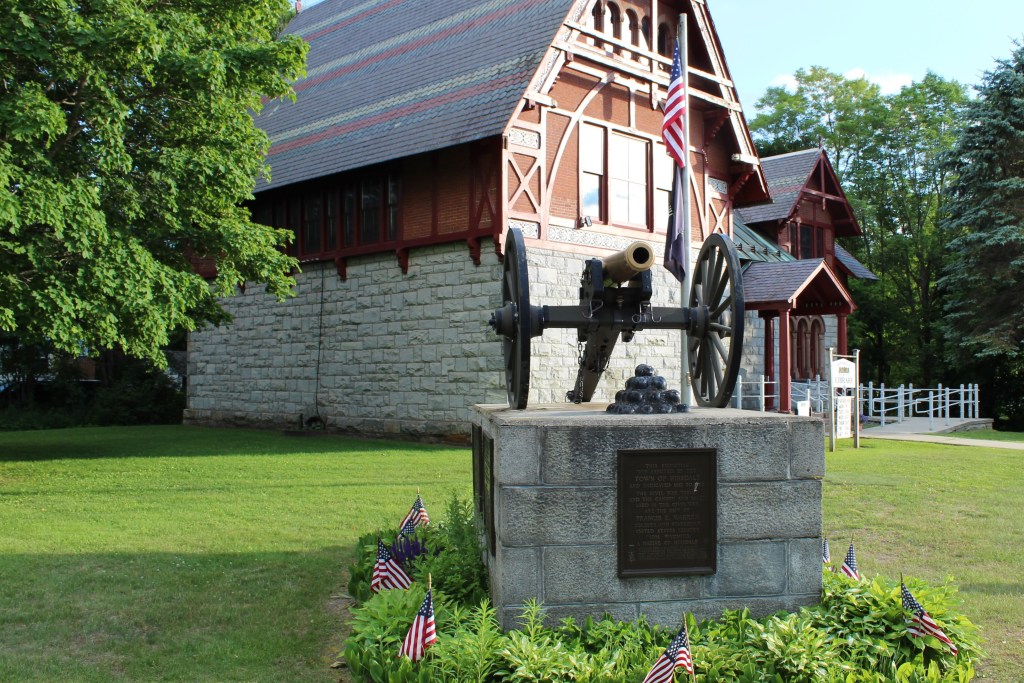
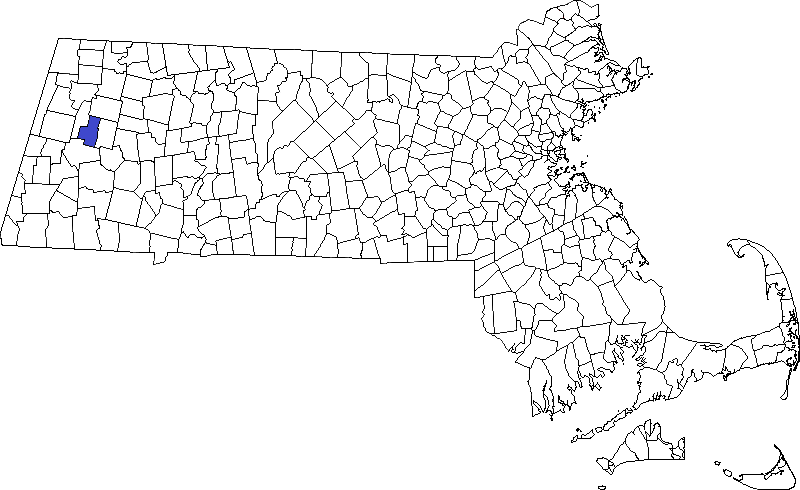
Location: In front of the Hinsdale Library, 58 Maple Street, Hinsdale
Coordinates: 42°31’16.8″N 72°54’51.0″W
Date dedicated: May 30, 1923
Design/Sculptor/Manufacturer: Unknown
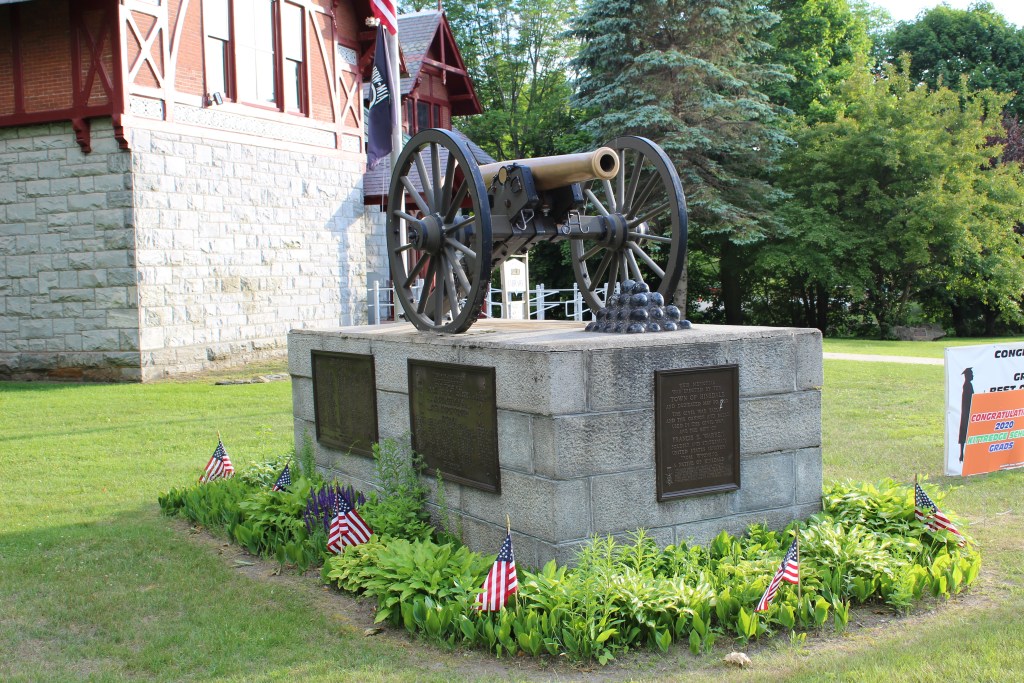
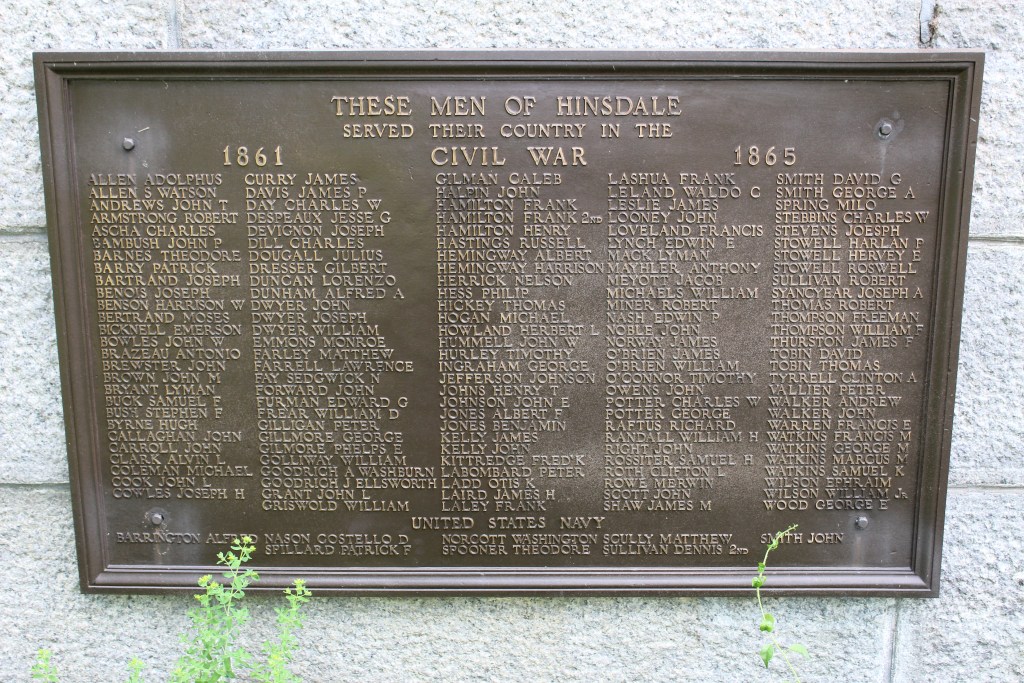
In 1923, the small Berkshire County town of Hinsdale dedicated a monument to honor its residents who served in American wars from the Revolutionary War to World War I. In ensuing years, additional plaques commemorating service in World War II, Korea, and Vietnam were added. While not exclusively a Civil War monument, it serves to memorialize the town’s Civil War soldiers, much like other “honor roll” memorials across Massachusetts. Moreover, the monument’s design places an emphasis on the Civil War, both aesthetically and historically.
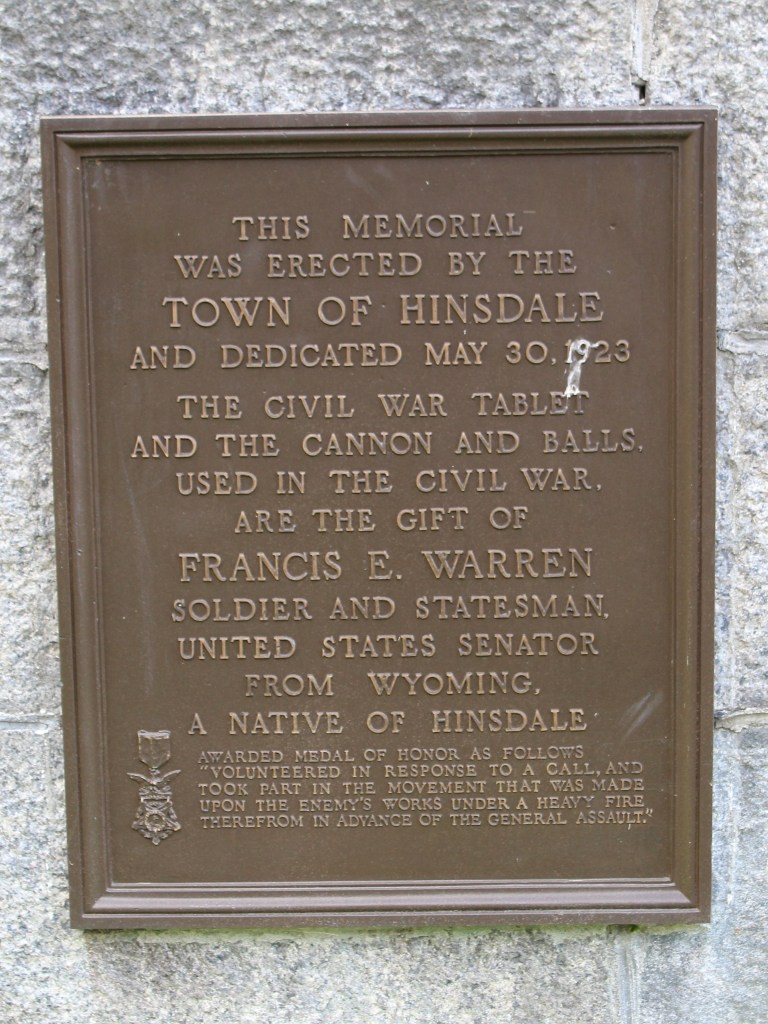
According to the monument’s “Civil War” tablet, 148 men from Hinsdale served in the Union cause. The dedication plaque reads: “This Memorial was erected by the Town of Hinsdale and dedicated, May 30, 1923. The Civil War tablet and cannon balls used in the Civil War are the gift of Francis E. Warren, soldier and statesman, United States Senator from Wyoming, a native of Hinsdale, awarded the Medal of Honor as follows: ‘volunteered in response to a call and took part in the movement that was made upon the enemy’s works under a heavy fire therefrom in advance of the main assault.’”
Francis Emroy Warren, born June 20, 1844, in Hinsdale, Massachusetts, stands out not only as a Civil War hero but also as one of the most prominent figures to emerge from this small town. Warren went on to achieve national renown as a statesman and the first governor of Wyoming. Warren was awarded the Medal of Honor for his bravery at the Battle of Port Hudson in Louisiana on May 27, 1863. At just 18 years old, Warren served as a private in the 49th Massachusetts Infantry, a regiment primarily composed of men from the Berkshire region. During the assault on the Confederate stronghold at Port Hudson, Warren volunteered for a “forlorn hope,” a term given to soldiers tasked with advancing ahead of the main assault to clear obstructions—often at great personal risk. Despite being wounded in this harrowing mission, Warren survived to complete his service with the regiment.
Hinsdale contributed significantly to the Union effort with approximately 22 men joining the 49th Massachusetts Infantry and around 20 enlisting in the 57th Massachusetts Infantry, among other regiments. The 57th, known as one of the “Veteran Regiments,” consisted of experienced soldiers reenlisting for additional service. This regiment saw heavy action during the Overland Campaign and the Siege of Petersburg in Virginia.[1]
On the occasion of the dedication, six surving Civil War veterans of the town were in attendance. The principal address was delivered by Rev. Stephen E. Keeler of Pittsfield. By 1923, the themes of war commemoration had shifted significantly. Keeler’s remarks naturally focused not on the Civil War itself but on broader reflections about patriotism, civic duty, and contemporary challenges. He reminded his listeners that “peace brings its crises as well as war” and that “political prejudices and corruption” represented a terrible threat to that peace and the spirit of reform. He spoke of the threat to “traditional” values, praised Prohibition, and called on Americans to lead the way as a world of “war wrecked” nations looked for leadership. Very different themes indeed than one might hear in 1867.[2]
Click images to enlarge:
[1] Massachusetts Soldiers, Sailors, and Marines in the Civil War (Boston: Massachusetts Adjutant General’s Office, 1931), volumes 4 and 5.
[2] Springfield Republican, May 31, 1923, 5.