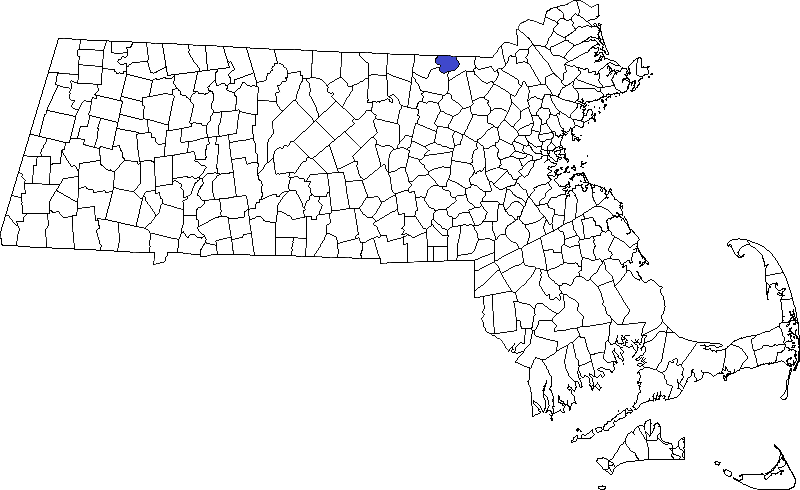
Location: In front of Dunstable Town Hall, 511 Main Street, Dunstable
Coordinates: 42°40’28.5″N 71°28’54.6″W
Date: November 11, 1996
Design/Manufacturer: Gate City Monument in Nashua, NH, monument design and cutting; Scouts of Troop 28 of Dunstable, foundation
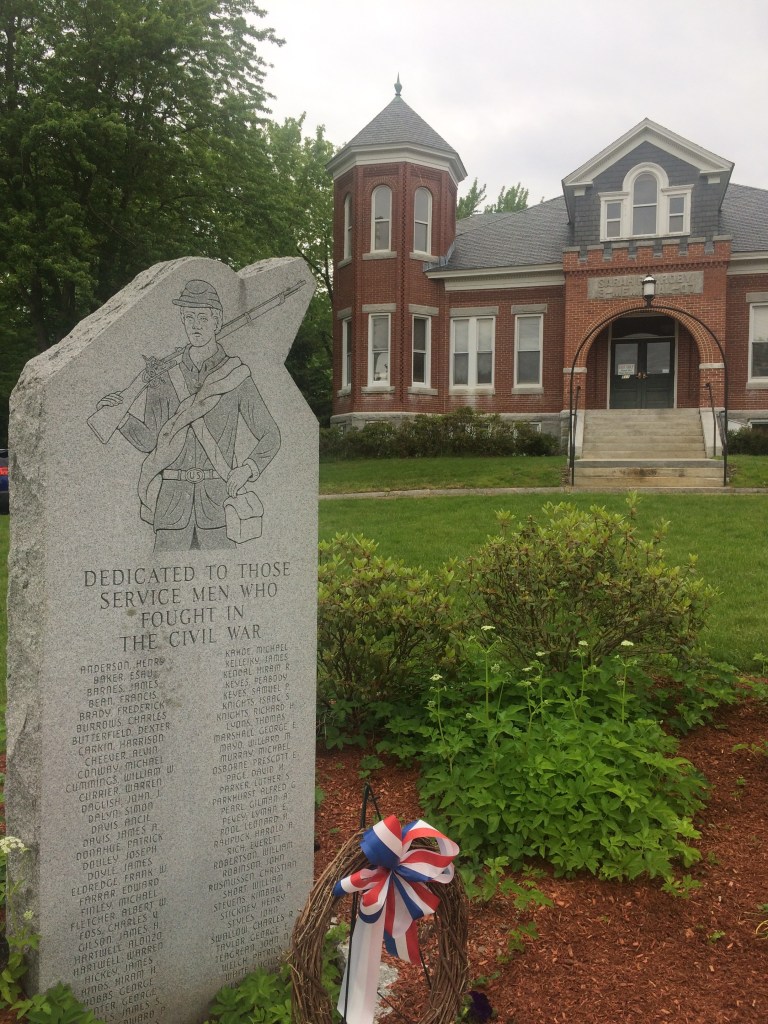
Considering that most of these monuments were built around 150 years ago, it’s exceedingly rare in the course of this project that I have the opportunity to correspond with someone involved in creating a town’s Civil War monument. Dunstable, however, is an exception. The Dunstable Civil War monument was conceived and brought to fruition by Tim Chase as his Eagle Scout project in 1996. Tim shared with me via email how the monument came to be:
“The Civil War Monument was my Eagle Scout Project in 1996. The funds were raised all through private donations from the residents of Dunstable, as well as several local organizations including the Rotary Club, Dunstable Grange, and the Methuen Chapter of the Sons of Union Veterans of the Civil War. The design and cutting of the monument was completed by Gate City Monument in Nashua, NH. The concrete foundation of the movement was hand dug and poured by the Scouts of Troop 28 in Dunstable.
“The inspiration for the project actually came from seeing the Civil War Monument in Shirley while studying the Civil War in High School. The distinct lack of a memorial in Dunstable honoring those who fought to preserve the Union…struck me as odd in a community that had monuments for both World Wars, the American Revolution, Korea, and Vietnam. The closest thing the town had was a watering trough donated to the town by Lieutenant Colonel Jonas French (Born in Boston, but with family ties to Dunstable) though it was meant as a respite for travelers not a memorial of the war in which he served.
“The monument contains the names of 69 individuals from Dunstable who served in the Civil War. The honor roll listed was gleaned from the Dunstable Town Reports following the end of hostilities…The formal dedication of the monument occurred in a public ceremony on November 11, 1996. Each year during the town’s Memorial Day Parade a wreath is laid before the monument by one local veteran and one local scout.”
New Civil War monuments are rare things in Massachusetts and this was indeed a commendable project undertaken by Mr. Chase.
Given its geographic location, it is perhaps not surprising that men from Dunstable served in both New Hampshire and Massachusetts regiments. Among those who enlisted in New Hampshire were Privates Willard M. Mayo and George E. Marshall, both 21 years old when they signed up with the 7th New Hampshire Infantry. This unit participated in the assault on Fort Wagner, outside Charleston, South Carolina, on July 18, 1863. This battle is well-known for the charge led by the 54th Massachusetts Infantry, a black regiment that fought with exceptional bravery and suffered heavy casualties. Other units that followed also faced severe losses; Private Mayo of Dunstable was killed in the charge across the beach on Morris Island, and Private Marshall was wounded, captured, and died a few days later.[1]
Another noteworthy figure, though not listed on the monument, is George Evans Davis, born in Dunstable in 1839. Having moved to Vermont before the war, he is not credited among Dunstable’s soldiers, yet his service is remarkable. Davis served as a captain in the 10th Vermont Volunteer Infantry and earned the Medal of Honor for his leadership during the Battle of Monocacy on July 9, 1864. There, he commanded a small force that successfully defended two bridges against repeated assaults by superior Confederate numbers, effectively delaying General Early’s advance toward Washington.[2]
[1] Henry F. W. Little, The Seventh Regiment New Hampshire Volunteers in the War of the Rebellion (Concord, NH: Seventh New Hampshire Veteran Association, 1896), 61-62.
[2] United States Army Center of Military History, “Medal of Honor Recipients”