
Location: Goere’s Square, West Main and East Main Streets, Avon
Coordinates: 42°07’54.9″N 71°02’25.1″W
Date dedicated: May 30, 1905
Architect/design/manufacturer: Unknown, possibly John Sullivan and Son, Taunton
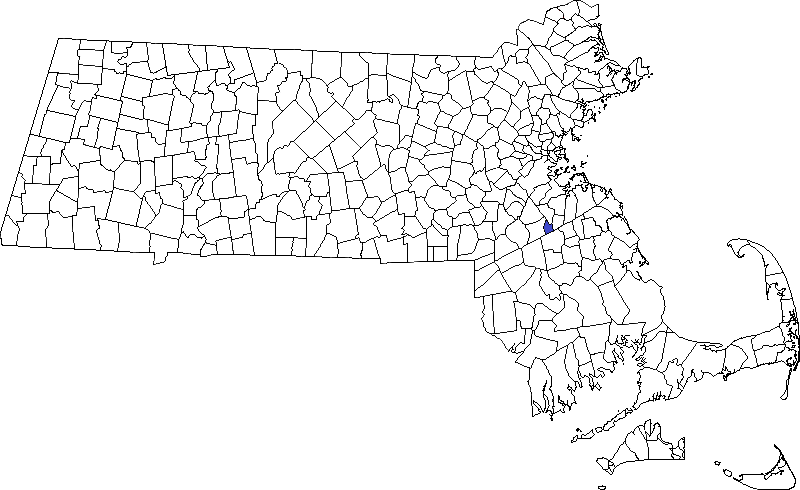
Avon did not exist during the Civil War—the area was known at the time as East Stoughton. It was set off from Stoughton in 1888 and annexed portions of Holbrook and Randolph a year later. Of the 38 Massachusetts municipalities created after the Civil War, 13 saw fit (or were able) to create a Civil War monument honoring those who lived specifically in their newly defined communities. Avon was one of these.
The monument was made possible through the generosity of Orlando Leach.[1] A native of East Stoughton (Avon), Leach worked in Boston during the early years of the war as a customs agent while studying law and was active in recruiting efforts. One source indicates he was given a captain’s commission (possibly as a recruiting officer?) but this is not confirmed by military records and may be incorrect. He was admitted to the bar in 1863 and in 1864, he went to the Sea Islands off the coast of South Carolina where “he was detailed to civil service duty” according to the Obituary Record of Yale Graduates.[2] This sounds like he may have been doing work associated with the Freedmen’s Bureau, which was quite active on the Sea Islands, but again, the specifics are unclear. What is clear, is that Leach founded several successful publishing companies after the war, producing textbooks on a wide variety of subjects. He was engaged in this work for decades, made quite a name for himself and apparently something of a fortune, and had a strong influence on educational publishing. He supported institutions in his home town in a variety of ways.
The address of the day of dedication, Memorial Day, 1905, was given by Rev. Charles E. Stowe, son of Harriet Beecher Stowe.[3] No account of his remarks is in evidence.
The statue itself is virtually identical to the one in Raynham which was constructed by John B. Sullivan and Son of Taunton. It seems highly likely that Sullivan and Son produced Avon’s as well, though that does not necessarily mean they did the actual statue carving. Theirs was a retail shop, selling work done by various granite companies such as the Smith Granite Company and the New England Granite Works.[4]
About 95 of the 530 soldiers and sailors sent by Stoughton to serve in the war came from East Stoughton, now Avon. Sixteen died in service.[5] East Stoughton was a boot-making village with several factories that attracted Irish immigrants looking for employment. It therefore is not surprising that the largest group of East Stoughton men to enlist signed up with the 9th Massachusetts Infantry—the Bay State’s first of two Irish regiments. Two others signed up with the second Irish regiment, the 28th Massachusetts. Both of them were killed in action, Sgt. Daniel Connery who was shot during the 28th’s charge up Marye Heights at the Battle of Fredericksburg, and William Currivan, who was wounded at Second Bull Run, discharged, reenlisted with the 56th Massachusetts and was killed during the Battle of the Wilderness.[6]
[1] Alfred S. Roe, Monuments, tablets and other memorials erected in Massachusetts to commemorate the service of her sons in the war of the rebellion, 1861-1865 (Boston: Wright and Potter Printers, 1910), 28.
[2] Obituary Record of Yale Graduates, 1915 – 1916 (New Haven: Tuttle, Morehouse, and Taylor, 1916),
[3] Roe, 28.
[4] “Sullivan Granite Company,” Babcock-Smith House Museum, https://babcocksmithhouse.org/sullivan-granite-company/
[5] William F. Hanna, The Story of Avon, Town of Avon website, chapter vii, page 3.
[6] Hanna, chapter vii, page 4.