

Location: Warwick Cemetery, 25 Holden Road, Warwick
Coordinates: 42°40’30.3″N 72°20’26.8″W
Date dedicated: completed in December 1866, dedication date unknown
Architect/design: Designed by J. E. Fuller of Worcester; Runnells, Clough, and Co. of Lowell, contractor.
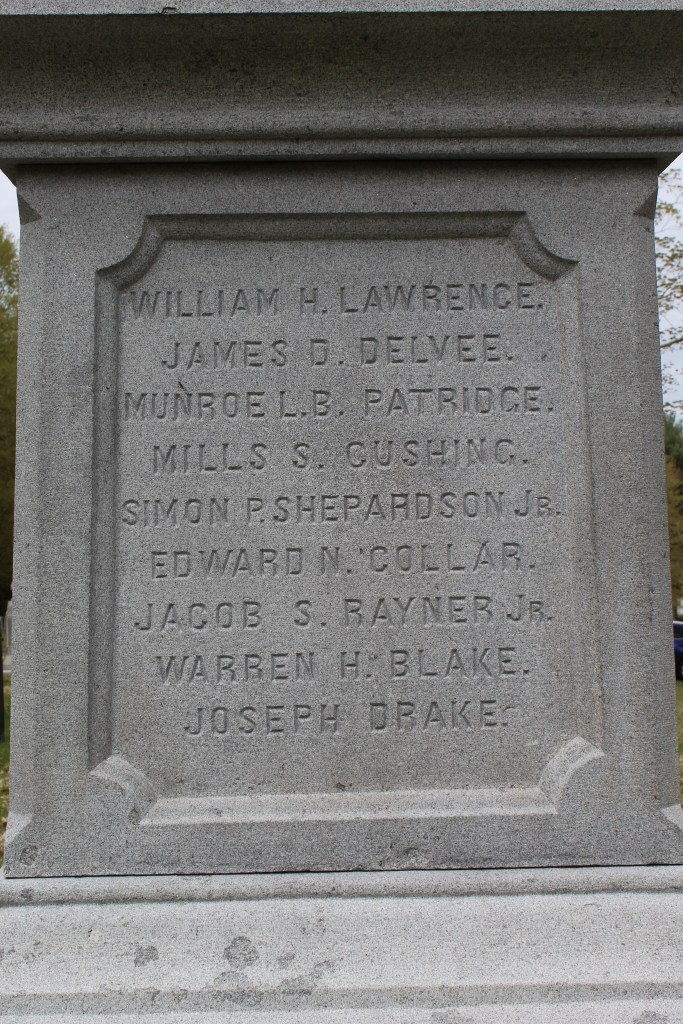
The monument in Warwick seems particularly touching to this author. It stands in the middle of a small, quiet cemetery in a rural area, surrounded by tall, wooded hills. The inscription at the foot of the obelisk informs the reader that, during the construction of the monument on November 22, 1866, Sgt. Alexander Cooper, a veteran of the war, was killed by the collapse of the derrick that was lifting the obelisk into place. Cooper had served more than two years with the 36th Massachusetts, was wounded during the assault on Petersburg, Virginia, but recovered after being sent home and discharged. Not to diminish the sacrifice and suffering of any of those who fell on the battlefield, but the fact that Sgt. Cooper had survived the maelstrom of war, returned to his wife and three children, but was killed in the process of building a memorial to his lost comrades and neighbors is particularly heart-rending. Sgt. Cooper is included in both newspaper accounts and local and state histories in Warwick’s tally of war dead, which seems appropriate to this author.
The town first voted to build a monument on November 7, 1865. During subsequent meetings of the Selectmen and the committee chosen to oversee the work, it was decided that the monument should be granite and erected in Warwick’s Cemetery (known at the time as Fisk Cemetery). The monument was designed by J. E. Fuller of Worcester (a native of Warwick) and carved by Runnells, Clough, and Co. of Lowell.[1] The stone came from a quarry in Fitzwilliam, New Hampshire. According to an 1873 history of Warwick, written by a committee, the monument symbolizes the role the town’s volunteers played in putting down the “great slaveholders’ rebellion.” The soldiers, according to the committee, showed “to the world that republican institutions are revered [by] preserving the Union, abolishing African slavery [and] enlarging the freedom of all…”[2]
The service of Capt. Charles A. Jones seems noteworthy in this regard. A 21 year-old shoemaker in Warwick at the start of the war, he mustered into the 21st Massachusetts Infantry (a central Massachusetts regiment) on August 19, 1861 as a private. His service earned him the attention of the regiment’s officers who recommended him for a commission in the 21st Massachusetts. Jones instead chose to accept a captaincy with the 1st North Carolina Colored Volunteers. The regiment, consisting of black soldiers commanded by white officers, was among the first black regiments organized in the country. It was brigaded with and served alongside the more famous 54th Massachusetts. During the Battle of Olustee, Florida, on February 20, 1864, Jones was killed while leading Company H. He was highly respected by the men of the two regiments in which he served. According to a brief article reporting Jones’s death, “The deceased possessed many excellent qualities of head and heart, and was beloved by all who knew him.”[3]
Overall, Warwick recruited 99 men.[4] The total of 26 dead is an unusually high casualty rate for Massachusetts towns.


[1] Springfield Republican, April 5, 1866, 8; Vermont Phoenix, December 14, 1866, 2.
[2] Hon. John Blake and Others, History of the Town of Warwick, Massachusetts, (Boston: Noyes, Holmes, and Co., 1873), 146-147.
[3] Boston Journal, March 4, 1864, 2.
[4] Blake and Others, 132.
What a tragic coda to a life of service and sacrifice! Has to be a rare instance of a veteran killed during the erection of a memorial. Thank you for this presentation.