Location: In front of Town Hall, 1 Constitution Way, Rochester
Coordinates: 41°43’56.4″N 70°49’20.4″W
Date dedicated: August 15, 1928
Design/Sculptor/Manufacturer: Unknown
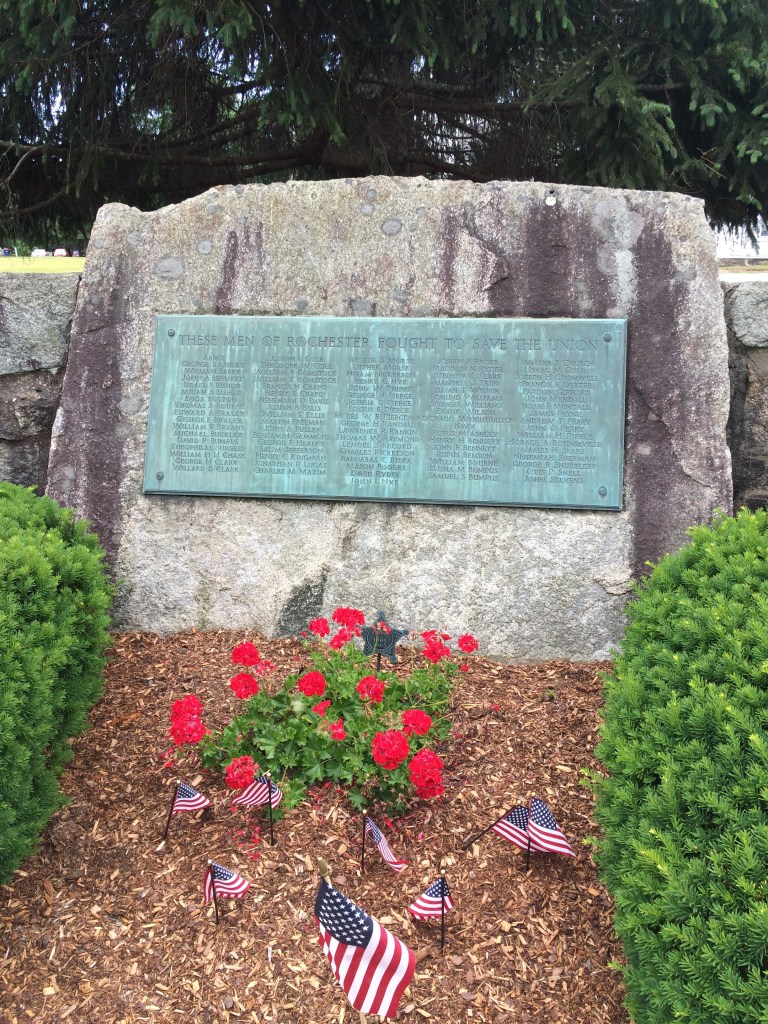
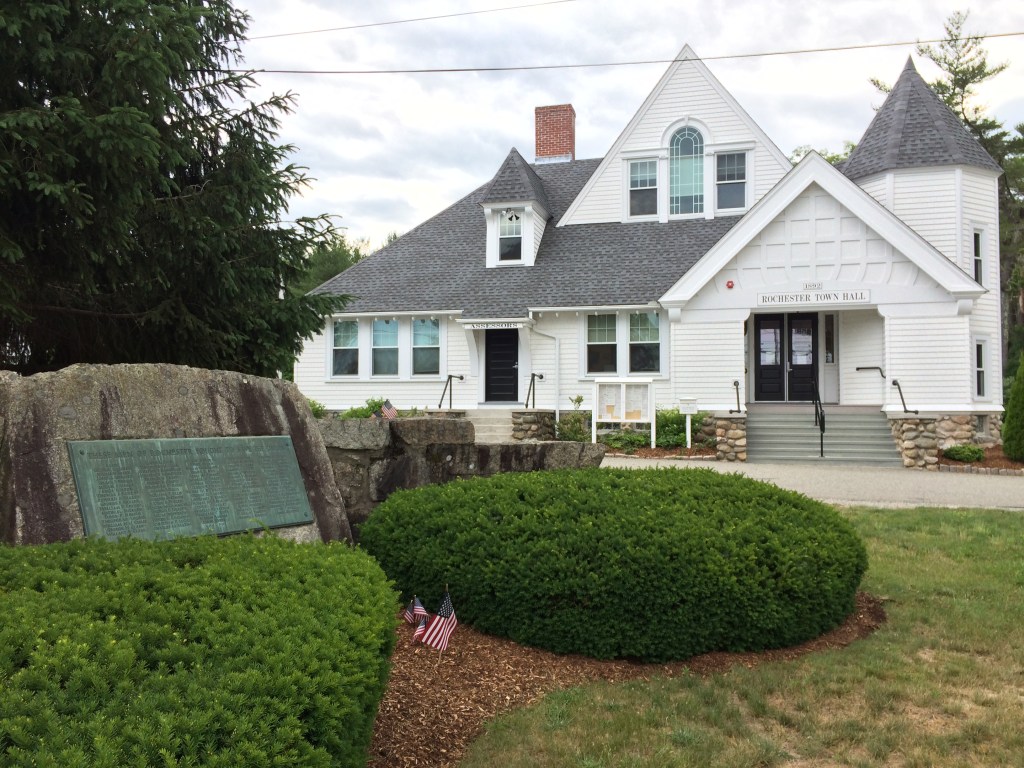
In front of the Rochester Town Hall in Massachusetts stands a monumental glacial boulder inscribed to honor the town’s Civil War soldiers. This rough-hewn memorial – originally dedicated in 1927 – bears a bronze plaque listing the names of 81 men from Rochester who served in the Civil War.
Rochester was a small rural town during the Civil War with a population of just 900. Approximately 81 Rochester men enlisted in army regiments or the navy during 1861–1865. At least nine of them lost their lives in the war.
Several Rochester volunteers served in the 38th Massachusetts Infantry, a regiment that saw hard service in Louisiana. The 38th Massachusetts fought in the Bayou Teche campaign and at the Siege of Port Hudson. Two young men from Rochester – Sgt. John Phipps and Pvt. William T. Bryant of Company H – died of disease in New Orleans hospitals while serving with the 38th.
Rochester men also enlisted in the 33rd Massachusetts, a regiment that eventually joined the Army of the Cumberland in the Western Theater. The 33rd Massachusetts fought in the Chattanooga Campaign, where it stormed the heights of Lookout Mountain in November 1863. Rochester’s George H. Clark of the 33rd was killed at the Battle of Lookout Mountain and two other local soldiers in the 33rd (Joseph P. Ryder and John A. Fuller) also fell during the war. Later, the 33rd Massachusetts marched with Sherman in the Atlanta Campaign.
One of the later war units with Rochester volunteers was the 58th Massachusetts, raised in 1864. This regiment was thrust into the bloody Overland and Petersburg campaigns. Rochester’s Pvt. Lawrence P. Rankin of the 58th Massachusetts was killed in action before Petersburg in June 1864 as the Union army pressed the siege of that Confederate stronghold.
A notable family of Rochester volunteers – the Besses – sent multiple members into the 18th Massachusetts. Three Besse brothers (Joshua, Ichabod, and Lathrop Besse) fought together in the Battles of Antietam and Gettysburg, joined by a young nephew, Benjamin B. Besse. Remarkably, Benjamin B. Besse had enlisted at only 15 years old and survived over forty engagements through the war’s end.[1]
By the early 20th century, Rochester had not yet erected a permanent town monument for its veterans of 1861–65. (An earlier, modest Civil War memorial, probably wooden, had been dedicated in 1872 on Rochester’s village green, but little of that remained by the 1920s.) With the Civil War’s surviving veterans aging, the town’s citizens sought a lasting tribute to honor all who served. In 1927, Rochester officials organized a committee to oversee the placement of a fitting memorial.[2]
The monument was installed directly in front of the Town Hall. Town Meeting appropriated $1,200 for the project. Surviving Civil War veterans gathered at the memorial’s dedication ceremony on August 15, 1928.[3] The massive boulder was unveiled with its bronze plaque listing Rochester’s Civil War soldiers. The chosen design of the memorial is striking in its simplicity and connection to the local landscape. And the Town Hall lawn (sometimes called Daggett Square) became not just a place associated with governance but also a shrine of remembrance.
[1] Rev. Nathaniel W. Everett, “Historical Address,” in Rochester’s Official Bi-Centennial Record, Tuesday, July 22, 1879 (New Bedford, MA: Mercury Publishing Co., 1879), 44-45.
[2] Town of Rochester (MA), Annual Report for the Year 1927 (Rochester, MA: Town of Rochester, 1928), 38.
[3] “Rochester Center Historic District,” Massachusetts Cultural Resources Information System, 10.