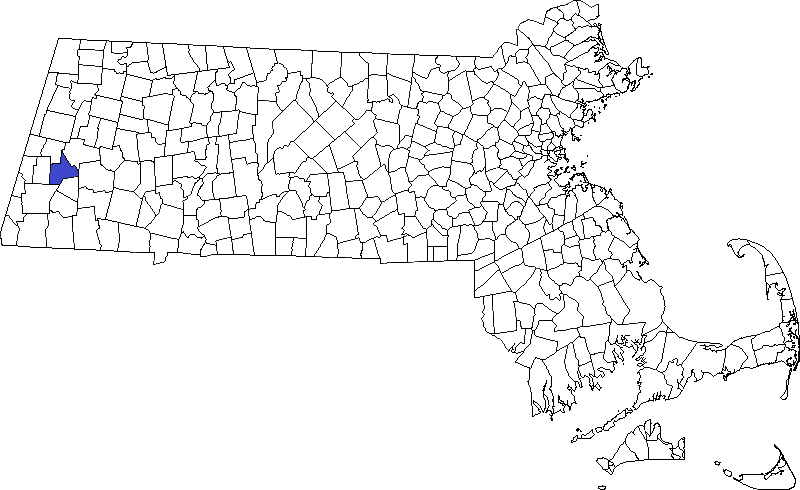
Location: Lee Memorial Hall, 32 Main Street, Lee
Coordinates: 42°18’18.2″N 73°14’56.4″W
Date dedicated: May 30, 1874
Design/Sculptor/Manufacturer: Marble tablets by Fuller and Maslen of Pittsfield; building architect, Charles T. Rathbun; contractor, A. D. and B. C. Munyan.
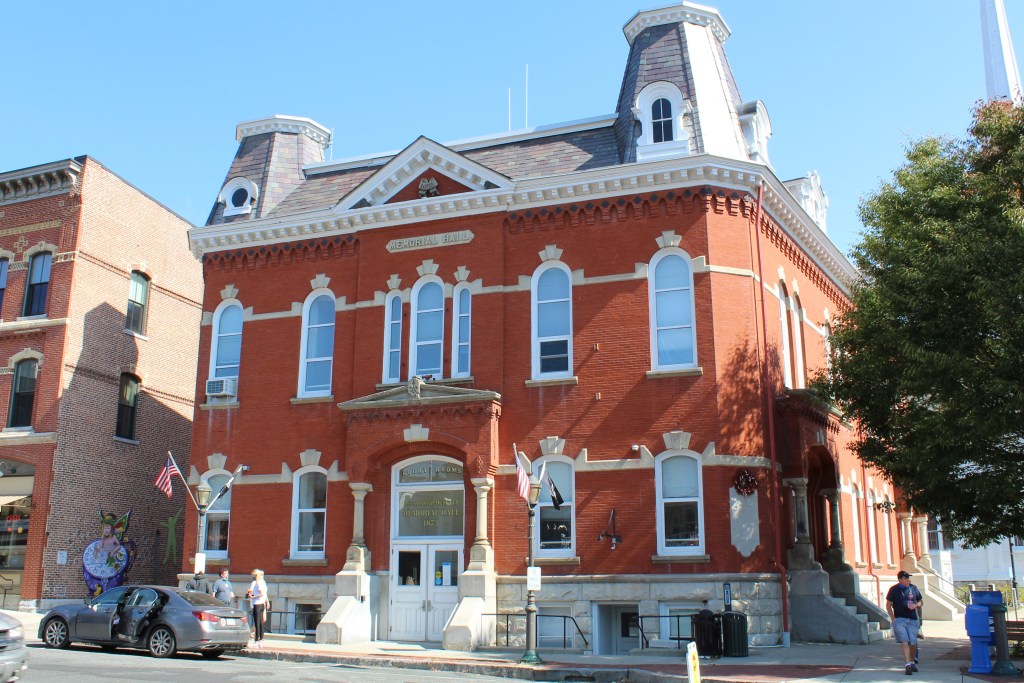
Memorial Town Hall in Lee, Massachusetts is a historic town hall and war memorial honoring local Civil War soldiers. It stands in the town center, facing a small park by the First Congregational Church. Built in 1873–1874 in a Second Empire style, this brick and marble-trimmed building was erected by the Town of Lee as a memorial to its sons who fell defending the Union in the Civil War. A stone tablet on the exterior reads, “Erected by the town of Lee in honor of the martyrs who fell and the heroes who fought in defense of liberty and Union.”
The building was dedicated on Memorial Day, May 30, 1874. The effort to create a permanent Civil War memorial in Lee was led by town leaders and citizens in the years following the war’s end. In 1873, a town meeting approved funding (about $22,000) for a new town hall dedicated to the fallen, and a building committee was appointed. Elizur Smith – a prominent local industrialist – served as chairman of the building committee and was a driving force behind the project. The hall was designed by Charles T. Rathbun, with construction carried out by A. D. & B. C. Munyan as builders.[1]
The Berkshire Eagle reported that the dedication of Memorial Hall was marked by some controversy, with dissatisfaction over the modesty of the program and the limited number of groups invited to participate. As the reporter wrote, “Memorial Hall has been dedicated, and it stands today a thing built, indeed, by a generous people… But dedicated amid general disgust, chagrin, and dissatisfaction.”[2] The article hints at deeper tensions within the community, noting a pervasive sense of bitterness surrounding the event. However, the author does not spell out the nature of this controversy, leaving us to wonder. We have seen in other towns how veterans often tended to reject Memorial Halls that doubled as entertainment space or meeting space for a wide variety of groups, instead often preferring dedicated monuments in hallowed cemeteries or quiet spaces. Whether that is the root of the controversy here, it’s impossible to say. But this example serves as a reminder that Civil War memorials could often be contentious matters.
From its opening, the building served multiple functions: it housed town offices, a post office, and an auditorium, and it provided meeting space for the local Post 131 of the Grand Army of the Republic. The Lee Library Association, founded in 1874, was granted two large rooms in Memorial Hall for the town’s library until a separate library building opened in 1907.
Just weeks after the Battle of Fort Sumter, the citizens of Lee convened and resolved that “a company of at least 64 men” should be raised for the Union war effort. The response exceeded expectations—over 100 men volunteered, forming a company that became known as the “Valley Guards.”[3] Unfortunately, by the time they organized, the state’s initial enlistment quota had already been met. When the Governor declined to accept the company, it was disbanded. The first men from Lee to successfully enlist were 22 who joined the 10th Massachusetts Infantry—the first regiment raised in western Massachusetts—and four others who joined Duryea’s Zouaves, which became the 5th New York Infantry.
According to one town history, local records indicate that 295 men from Lee served in the Civil War. However, state records place the number significantly higher—closer to 400. This discrepancy is likely due to the fact that volunteers recruited from other towns were credited to Lee’s quota (this was done across the state). Additionally, the town’s historian noted that local records were likely incomplete, suggesting the lower figure may underrepresent Lee’s actual contribution.[4]
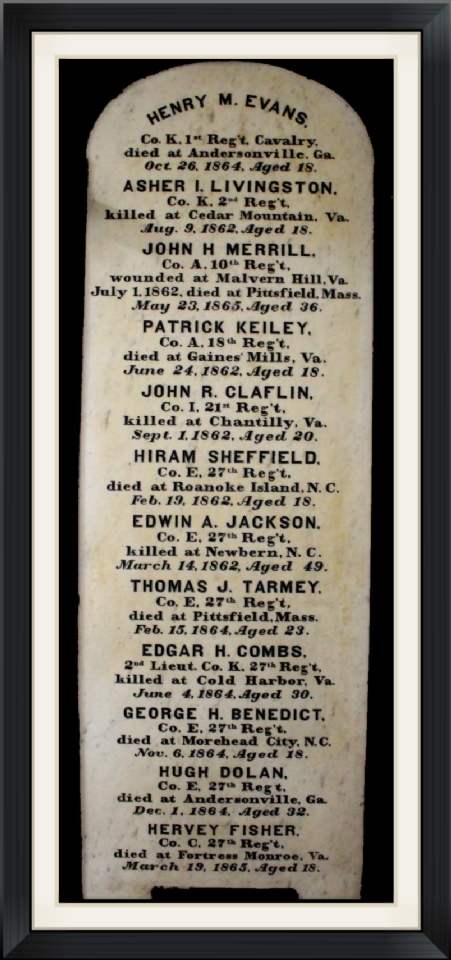
Out of those who served, 38 men from Lee died due to battle or disease during the war. Their names are immortalized on three marble tablets inside Memorial Hall’s vestibule. Ten of these were killed in action, four died of battle wounds, 17 died of disease, four died as prisoners at Andersonville, and one died in an accident.
Company E of the 27th Massachusetts Infantry was raised in part in Lee, led by Lieutenant Luther Bradley and included 25 volunteers from the town. The 27th Massachusetts served primarily in the Department of North Carolina and participated in key operations such as the capture of Roanoke Island and the battles of New Bern and Kinston. In 1864, the regiment was transferred to Virginia and took part in the grueling Overland Campaign, including the battles of Cold Harbor and Petersburg, suffering heavy casualties.
By 1863–64, many new recruits from Lee joined the 37th Massachusetts Infantry, a regiment formed largely from Berkshire County. The 37th initially served in the defenses of Washington but was soon drawn into some of the fiercest fighting of the war. It played significant roles in the battles of Fredericksburg, Chancellorsville, Gettysburg, the Wilderness, Spotsylvania, and the Siege of Petersburg. The regiment endured heavy losses during Grant’s Overland Campaign and in the final push toward Appomattox. Among its Lee contingent was Captain Franklin W. Pease, the highest-ranking soldier from the town to fall during the war, who was mortally wounded at Spotsylvania in May 1864.
Click photos to enlarge:



[1] Rev. C. M. Hyde and Alexander Hyde, Lee, The Centennial Celebration, and Centennial History of the Town of Lee, Mass. (Springfield: Bryan and Co. Printers, 1878), 184.
[2] Berkshire County Eagle, June 4, 1874.
[3] Hyde and Hyde, 169.
[4] Hyde and Hyde, 174.