
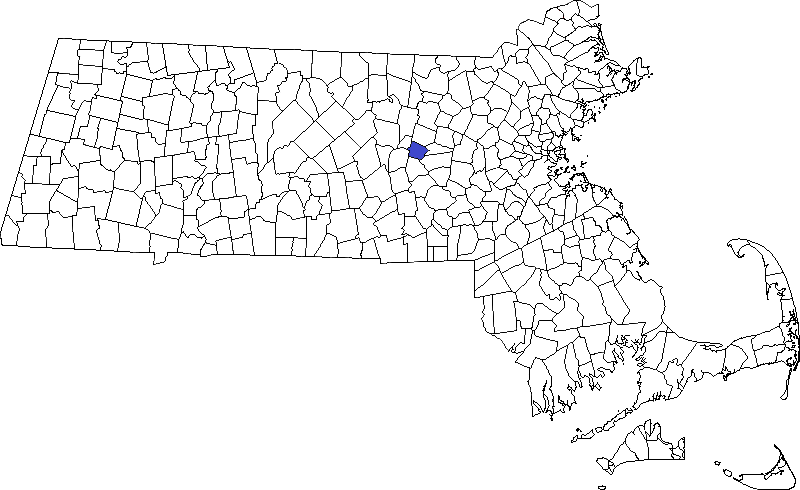
Location: 1870 Town Hall, 12 Woodward Avenue, Berlin
Coordinates: 42°22’54.6″N 71°38’13.3″W
Date dedicated: March 2, 1870
Design/Manufacturer: Tablets by Benjamin Harris Kinney of Worcester
On March 2, 1870, residents of the town of Berlin, Massachusetts, along with many guests from near and far, assembled in the new town hall to celebrate its completion. It was not, however, merely a building that they were dedicating on that day. The key component of the proceedings was the dedication of tablets listing those from the town who died during the recent Civil War and the Memorial Hall in which they were mounted. The room would be used by the local Grand Army of the Republic veterans for their meetings over the next decades. Today, it is still reserved as a Civil War memorial, and though only opened for special occasions, it still remains fundamentally in its original condition.
Originally built to house not only a memorial hall but also town offices, a large auditorium or “Grand Hall,” a library, a police station, and more, the building closed in 1998 when the town offices moved to other quarters. In serious disrepair, the building was in jeopardy until local efforts got underway to restore the building from 2005 to 2007.[1] Today the second floor “Grand Hall” as well as other smaller meeting rooms, are frequently used for community events and private functions. Memorial Hall on the first floor is not used for functions but instead is preserved as a museum honoring Berlin’s Civil War dead.
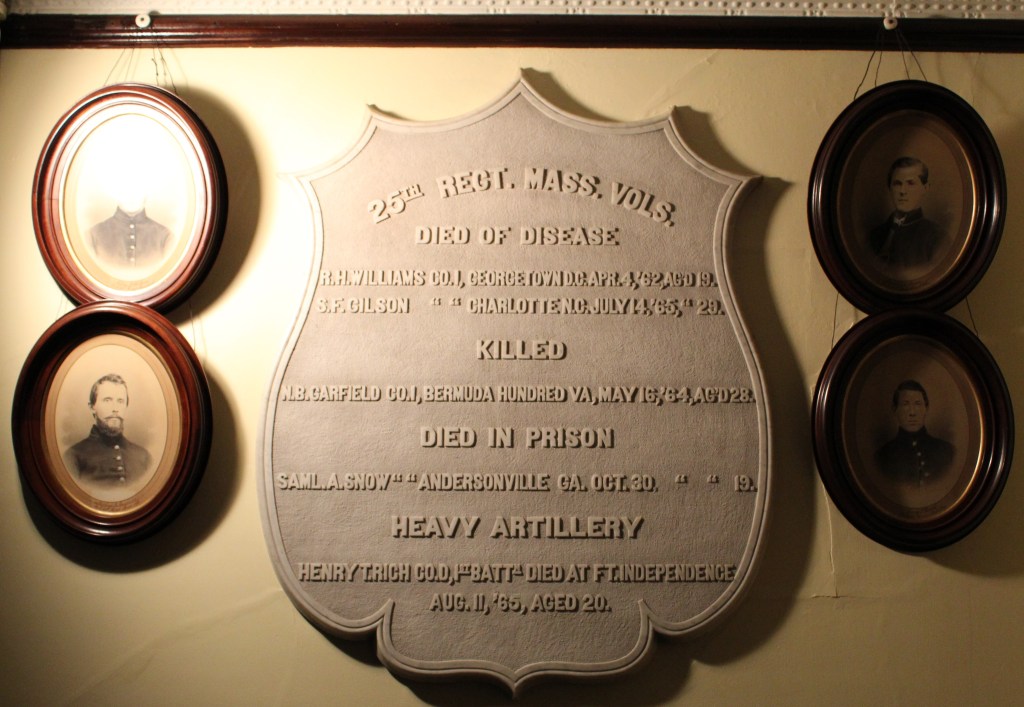
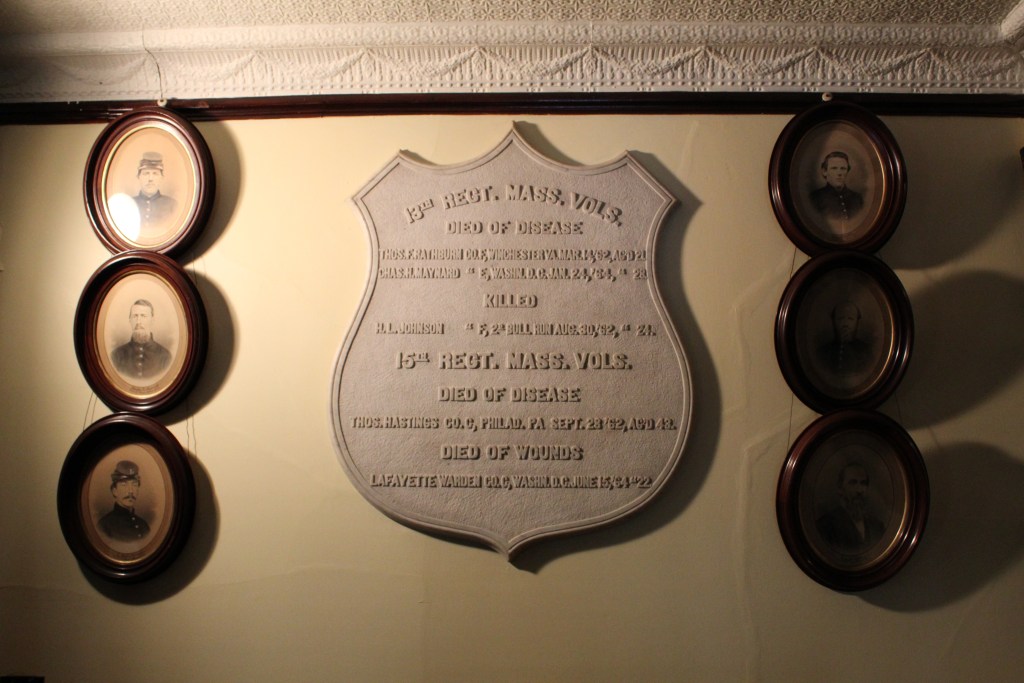
The hall features a sizeable collection of artifacts, including the flag used by the town’s prewar militia company. Photographs of Civil War soldiers line the walls. The most prominent features are four large, marble, shield-shaped tablets listing the 22 men from Berlin who died in the war. Memorial Hall was also used for meetings of the Women’s Relief Corps and the Sons of Union Veterans.[2]
During the dedication exercises, William Bassett, speaking on behalf of the Building Committee, said that the structure was needed not only for social and municipal purposes but to give “to the soldiers returned from the late war, a suitable place for meeting and consultation; but not least was it the intention that a more fit place should be prepared for the reception of the soldiers’ memorial tablets, which are to transmit to future generations the names of those who perished in the great rebellion…”[3]
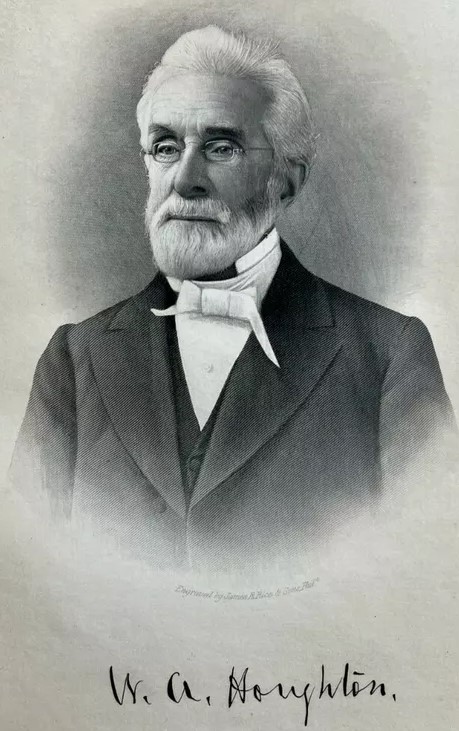
In giving the “Memorial Address,” Rev. William A. Houghton of Berlin recounted the history of the town’s involvement in the war. He indicated that 139 men from that town of roughly 1,000 went off to war. He highlighted the service of each of the fallen—each story poignant and too much to adequately summarize here. But one, perhaps stands out due to its sad irony. Private Nathan B. Garfield, a “diffident and retiring young man,” was deemed the least likely, according to Houghton, “to make a soldier. But none were more ready at duty’s call for any conflict.” Nathan was frail and repeatedly rejected for service. Finally, after several attempts, he was accepted into the 25th Massachusetts Infantry. Due to his limited physical condition, he was relegated to hospital duty for his first two years of service. But he repeatedly asked to serve on the battlefield with the rest of his unit. This request was finally granted and soon after taking the field, Corporal Garfield was killed in action during the relatively minor Battle of Swift Creek, Virginia. He was buried on the field by one of his townsmen from Berlin.[4]
Commander E. H. Hartshorn, in accepting the tablets and Memorial Hall on behalf of the local Grand Army of the Republic post, said “We assure you that to no better hands could you entrust them, for they have faced suffering and death side by side with those who have fallen, and will appreciate as you cannot their sacrifice.”[5]
Click to enlarge images:



[1] Donna Robertson, “Berlin’s Old Town Hall is New Again with Activity,” Telegram & Gazette, July 1, 2008. https://www.telegram.com/story/news/local/north/2008/07/01/berlin-s-old-town-hall/52358459007/
[2] Massachusetts Historical Commission, 1870 Berlin Town Hall National Register of Historic Places Nomination Form, pages 2, 8. https://mhc-macris.net/details?mhcid=brl.193
[3] Memorial Record of the Soldiers of Berlin in the Great Rebellion, with the exercises at the dedication of the tablets of the deceased, memorial hall, and town house (Clinton, Massachusetts: W. J. Coulter, Courant Office, 1870), 8.
[4] Houghton’s remarks, Memorial Record, 21-22.
[5] Memorial Record, 28.