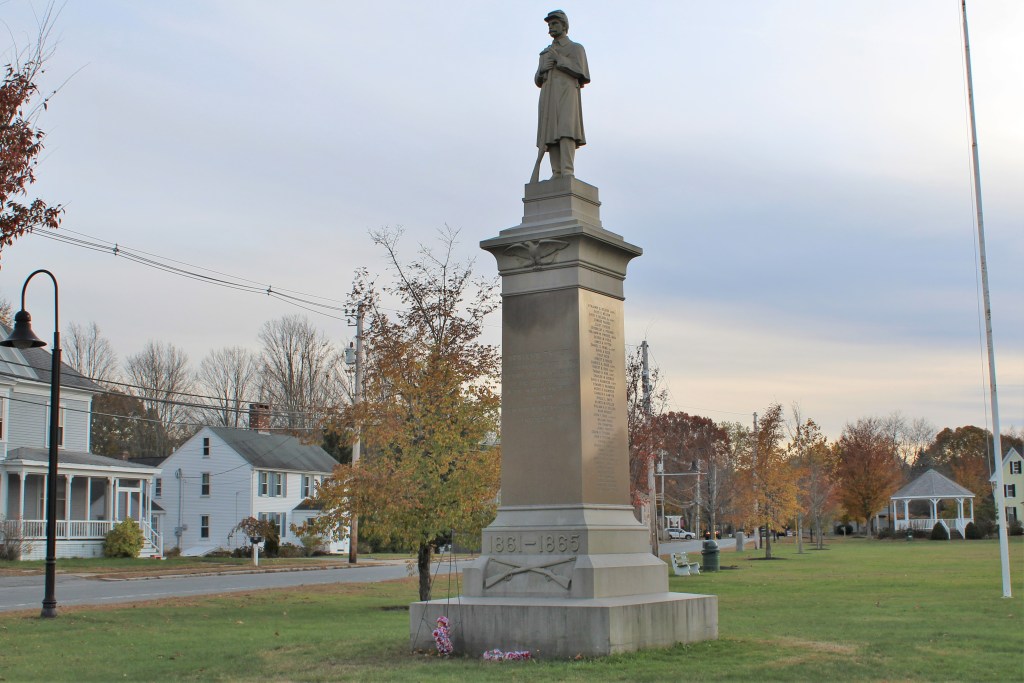

Location: Town Common, Summer and Main Streets, Rowley
Coordinates: 42°42’50.7″N 70°52’52.6″W
Date dedicated: December 12, 1914
Architect/design: Possibly John B. Sullivan of Taunton, MA
Rowley’s memorial appeared late for a Civil War monument. Its construction was hindered by some legal troubles. The nucleus of a fund for a soldiers monument was established in 1873. A committee of trustees solicited donations in the usual manner, however the effort stalled out and the funds on hand languished for roughly 40 years. In 1913, when the matter was taken up again, there was some dispute as to who had control of the funds. A new association of trustees claimed to be successors of the original committee and contracted with a manufacturer to build a monument in the town cemetery. The selectmen blocked this, claiming control of the funds, and began building the existing monument on the Town Common in 1913.[1]
It is another example, this one perhaps more extreme than others, of the differences that persisted over whether Civil War monuments should be in sacred spaces or at the heart of civic life. This was particularly unclear in the immediate wake of the war as most towns really had no extant traditions defining what a war memorial should be. Even decades after the Civil War, as seen in Rowley, differences of opinion on the proper setting for memorials persisted.
The monument was dedicated on December 12, 1914. The primary inscription reads, “Rowley’s tribute to her men who were in the military or naval service of the United States in the war to preserve the Union.” The statue is nearly identical to the one in Raynham, Massachusetts, erected in 1899 and carved by John B. Sullivan of Taunton, Massachusetts. Sullivan may or may not have carved Rowley’s monument, but to be sure, they were based on the same design.
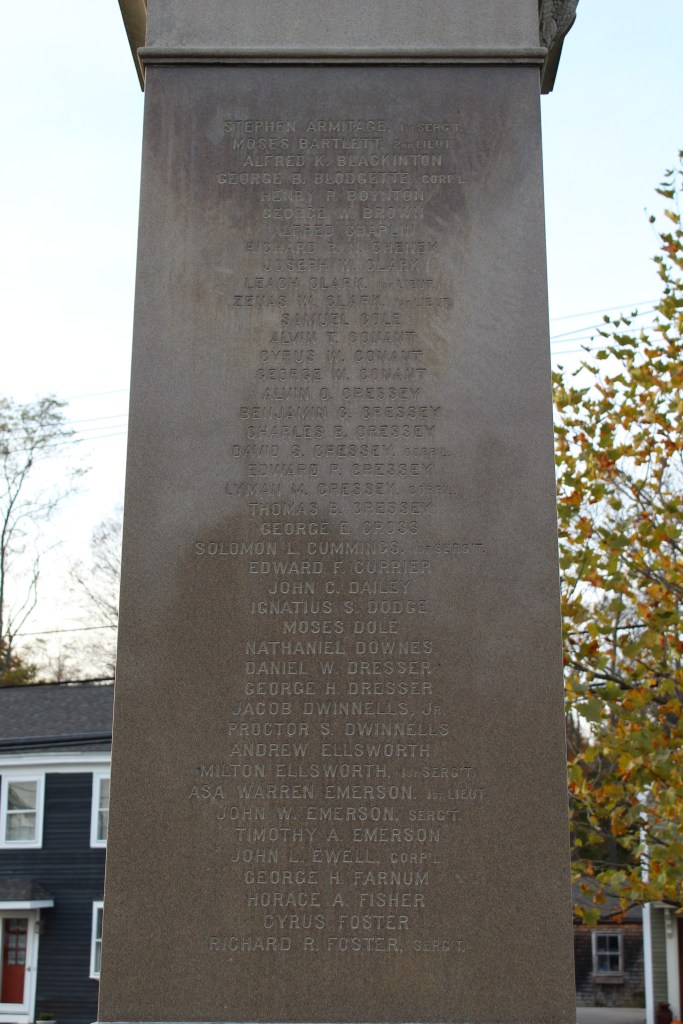
On the pedestal are the names of the 128 men from the town who served. Of these, approximately 16 did not survive…exact figures are not readily available from local sources. A quarter of these casualties died during the Port Hudson campaign in Louisiana while serving with the 48th Massachusetts Infantry—three of them from disease and one killed during the assault on Port Hudson. Nearly all of Rowley’s war dead were shoemakers, four of them farmers, and one listed as a “gentleman.”[2]


[1] “Seek Fund Left for Monument to Veterans of War, The Daily Item (Lynn, MA), September 24, 1914, 14.
[2] Massachusetts Soldiers, Sailors, and Marines in the Civil War (Boston: Massachusetts Adjutant General’s Office, 1931-1937).